Katalyst Mission Launches to Rescue Swift Telescope
A commercial Katalyst spacecraft launched in late June 2026 to grab and reboost NASA's Swift observatory before its orbit decays.

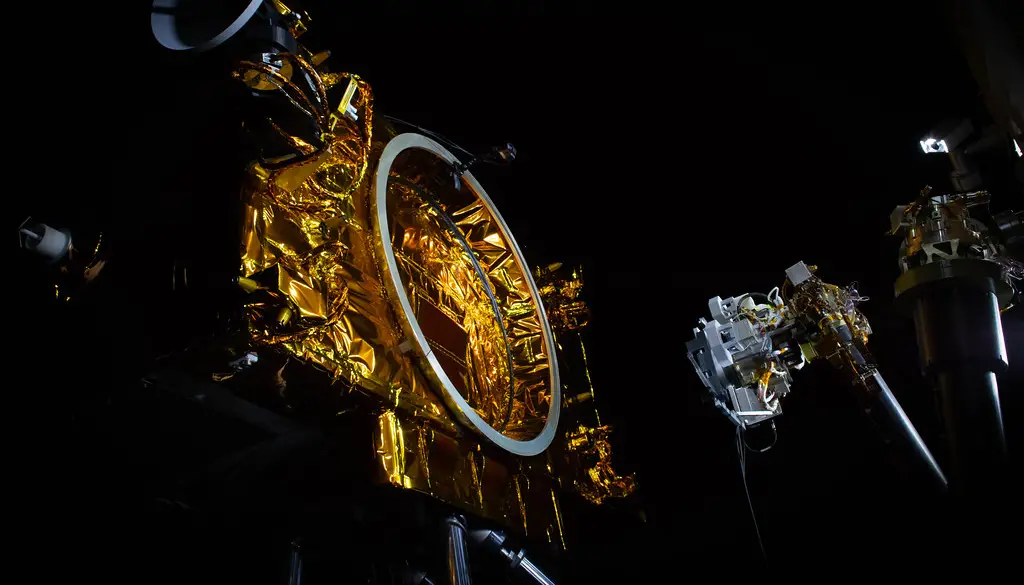
In late June 2026, a commercial spacecraft built by Katalyst Space Technologies launched on a daring mission to save NASA's aging Neil Gehrels Swift Observatory, a telescope that was never designed to be caught, and whose orbit has been falling toward an early reentry. The robotic servicer, called LINK, is meant to chase Swift down, grab it, and slowly nudge its altitude back up over several months. Pull it off, and it becomes a milestone for a whole industry built on rescuing satellites in trouble.
Quick answer
Katalyst's LINK spacecraft launched in late June 2026 on a Northrop Grumman Pegasus XL air-launched rocket to rescue NASA's Swift observatory, whose 21-year-old low orbit has decayed faster than expected because heightened solar activity puffed up the upper atmosphere and increased drag. LINK will spend weeks in commissioning, then rendezvous with Swift, grapple it with robotic arms, and gradually raise its orbit to nearly 370 miles over several months. Swift was not built to be serviced, so this doubles as a proof of concept for commercial in-orbit servicing.
Key takeaways
- Katalyst's LINK spacecraft launched in late June 2026 on a Northrop Grumman Pegasus XL air-launched rocket.
- Its mission is to grapple NASA's Swift observatory and raise its orbit to nearly 370 miles.
- Swift's low orbit has decayed rapidly due to increased solar activity over its 21-year life.
- Katalyst had less than a year to design, build, test, and launch the servicer after being contracted.
- The reboost will unfold over several months following commissioning and rendezvous.
What happened
NASA and Katalyst readied a mission to raise the orbit of the Neil Gehrels Swift Observatory, a space telescope that has studied gamma-ray bursts and other high-energy events for more than two decades. The robotic servicing satellite LINK launched on a Northrop Grumman Pegasus XL, an air-launched rocket released from a carrier aircraft.
Once in orbit, LINK is set to undergo several weeks of commissioning while Katalyst evaluates its propulsion, navigation, and sensor systems. It will then approach and survey Swift before grappling the observatory with its robotic arms and gradually raising its orbit to nearly 370 miles.
Note
Air-launched rockets like the Pegasus XL are carried aloft by an aircraft and released at altitude before igniting. That gives flexibility in launch location and timing compared with a fixed ground pad, and it is well suited to placing a small servicer into a specific orbit to match a target.
The mission in phases
A rescue like this is not a single maneuver but a sequence, each step riskier than the last. Here is how it breaks down and where the danger sits.
| Phase | What happens | Why it is hard |
|---|---|---|
| Commissioning | Weeks of checking LINK's propulsion, navigation, and sensors | A fault here can scrub the whole mission before it starts |
| Rendezvous | LINK approaches and surveys Swift up close | Matching orbits with a non-cooperative, tumbling target |
| Capture | Robotic arms grapple a telescope with no docking fixture | Swift has no grapple points; a bad grab could damage it |
| Reboost | Slowly raise the orbit toward 370 miles over months | Must thrust gently to avoid stressing an old structure |
Why it matters
Swift was not built to be serviced, and that is the crux of the challenge. It has no docking adapter, no grapple fixtures, and no design accommodation for a robot grabbing it. Catching and reboosting an object like that is genuinely hard. After 21 years, its low Earth orbit began decaying quickly because of heightened solar activity, which expands the upper atmosphere and increases drag on satellites. Without intervention, the telescope risked reentering the atmosphere later in 2026, ending a mission that still does productive science on gamma-ray bursts and transient events.
The mission is also a proof point for commercial satellite servicing. NASA contracted a private company to design, build, and fly a rescue spacecraft in under a year, a strikingly fast timeline for spaceflight, demonstrating a model in which aging or stranded assets in orbit can be saved rather than written off. If servicers can capture uncooperative satellites, the same capabilities open the door to refueling, repair, and orbit changes across the fleet.
Why Swift is worth saving
Swift is not just any aging satellite. Launched in 2004 and later renamed for astrophysicist Neil Gehrels, it was built to catch gamma-ray bursts, the brief, enormously energetic flashes that mark some of the most violent events in the universe, such as collapsing massive stars and merging neutron stars. Its trick is speed: it can detect a burst and swing its telescopes onto the target within roughly a minute, then alert observatories around the world to look. Over more than two decades it has studied thousands of bursts, comets, supernovae, and other transient events, and it remains a workhorse in the network of instruments that respond when something suddenly lights up in the sky.
That productivity is exactly why a rescue makes sense. Building and launching a replacement would cost far more than nudging a working telescope back to a safe altitude, assuming the capture succeeds. For a few months of careful robotic maneuvering, NASA potentially buys years more science from hardware that already exists and still works.
The bigger picture
If LINK succeeds, it would extend the working life of a productive science mission and validate techniques for capturing uncooperative spacecraft. Those same capabilities could eventually support refueling, repair, and orbit changes for satellites that were never designed for servicing.
There is a bigger reason this matters: orbital debris and orbit congestion. Every satellite that reenters safely or gets reboosted instead of dying in a crowded altitude is one fewer collision risk. Active management of orbit, where operators tow, refuel, or deorbit hardware on purpose, is the only sustainable path as low Earth orbit fills with constellations. The effort reflects a broader shift toward treating orbit as an environment that can be actively managed, not just launched into and abandoned. It joins a busy stretch of high-profile space activity in 2026, including the milestone arrival of NASA's Roman Space Telescope at Kennedy and the run-up to SpaceX's record IPO.
What to watch next
- Commissioning. Katalyst will spend weeks checking LINK's propulsion, navigation, and sensors before approaching Swift.
- Rendezvous and capture. The servicer must safely grapple a telescope never designed to be grabbed.
- Reboost. Raising Swift's orbit to nearly 370 miles will take several months.
- Servicing precedent. Success would strengthen the case for commercial in-orbit servicing more broadly.
Frequently asked questions
Why is Swift's orbit decaying?
Increased solar activity has expanded the upper atmosphere, raising drag on satellites in low Earth orbit. After 21 years, that drag began pulling Swift down faster toward reentry.
What is LINK?
LINK is the robotic servicing spacecraft built by Katalyst Space Technologies. It is designed to rendezvous with Swift, grapple it with robotic arms, and slowly raise its orbit.
How was LINK launched?
It launched on a Northrop Grumman Pegasus XL, an air-launched rocket carried aloft by an aircraft and released before ignition.
How long will the reboost take?
After several weeks of commissioning and a careful rendezvous, raising Swift's orbit to nearly 370 miles is expected to take several months. The thrust has to be gentle, applied gradually so it does not stress a 21-year-old structure that was never built to be pushed.
What happens if the capture fails?
A failed grapple is the mission's biggest risk because Swift has no docking fixture to grab. If LINK cannot get a safe hold, controllers would back it off rather than risk damaging the telescope, and Swift would continue its decay toward reentry. That is exactly why the approach and survey phase is so deliberate.
Why is solar activity making orbits decay faster?
The Sun runs on roughly an 11-year cycle, and near its peak it heats and expands Earth's upper atmosphere. That expansion pushes thin atmosphere up into the altitudes where low-orbit satellites fly, increasing drag and pulling them down faster than during quiet solar years. Swift simply hit that headwind late in its long life.
The Swift rescue is a high-stakes test of commercial satellite servicing, with the potential to extend a long-running science mission and prove that orbit can be actively managed rather than treated as a place you launch into and abandon.
Sources & further reading
- science.nasa.gov/missions/swift/swift-boost-mission/partners-nasa-ready-for-june-launch-of-swift-boost-mission/
- nasa.gov/news-release/nasa-to-preview-katalyst-mission-to-boost-swift-spacecrafts-orbit/
- space.com/space-exploration/launches-spacecraft/no-one-thought-it-was-going-to-be-possible-a-space-telescope-is-falling-out-of-space-this-is-nasas-daring-plan-to-save-it
- science.nasa.gov/blogs/swift/2026/06/29/what-to-expect-commercial-mission-to-boost-nasas-swift/